Denver’s pool season runs roughly mid-June through early August for about ten weeks. At 5,280 feet, your pool chemistry, equipment, and timing all play by different rules. This guide covers every step of summer pool preparation with Denver-specific factors built in.
Why Denver Pools Need a Different Prep Approach
Altitude changes your water chemistry. UV radiation at a mile above sea level is significantly more intense, which breaks down chlorine faster. A pool that tests at safe chlorine levels Monday morning can drop below effective thresholds by Wednesday even without heavy use. Water evaporates faster too, concentrating minerals and shifting your chemical balance between tests.
Front Range water is hard. Municipal water across the Denver metro runs high in calcium and dissolved minerals. Your calcium hardness is already elevated before you add a single chemical. Adding calcium hardness without testing first leads to aggressive scaling on tile, plaster, and equipment.
Spring weather is unpredictable. Denver’s last frost typically falls in mid-May, but cold snaps in early June aren’t unusual. Opening too early risks freeze damage to freshly reconnected plumbing. And those 30-degree day-to-night temperature swings create ideal conditions for early-season algae blooms.

When to Start Preparing Your Pool in Denver
Start physical prep in late May, target swim-ready by the first or second week of June. Denver Parks and Recreation typically opens public pools around June 8–14 each year, a good reference point for when the season begins.
Don’t open before late May. Overnight temperatures in the 30s and 40s can persist into early June, especially in higher-elevation neighborhoods like Evergreen, Conifer, or parts of Highlands Ranch. But don’t wait until July either, that’s three or four lost weekends out of an already short season.
Step 1: Remove and Clean Your Pool Cover
Clear standing water, leaves, and debris off the cover before removing it. Use a cover pump for water and a leaf blower for dry material. Wash the cover with a mild cleaner, dry it completely, then store it in a cool, dry space. A wet-stored cover develops mildew and degrades faster.
Cottonwood trees start dropping fluffy seeds across the metro in late May through June. That fluff accumulates on covers fast and clogs skimmer baskets within hours of opening. If cottonwoods are heavy in your area, time your cover removal around this active skimming beats letting seeds pile up.
Step 2: Inspect the Pool Structure and Deck
Denver’s freeze-thaw cycles widen small cracks over the winter. Check for cracked or chipped waterline tiles, loose coping stones, and separation between the pool shell and deck. On plaster pools, look for rough patches or chalky texture signs of surface degradation.
Pay special attention to your deck. Colorado’s expansive clay soils common across the southern and western suburbs cause concrete to heave and shift seasonally. Uneven sections are a safety hazard around a wet pool area. Also inspect ladders, handrails, and diving board hardware for rust or loose bolts.
Step 3: Reconnect and Test Your Pool Equipment
Reconnect pumps, filters, heaters, and chlorinators. Reinstall drain plugs, check all valves, then run the system for 15 to 20 minutes watching for leaks, unusual noises, and proper water circulation. If the filter pressure gauge reads high immediately, the media likely needs cleaning or replacement after winter.
For Denver homeowners with variable-speed pumps: program your summer schedule now. Run the pump a minimum eight hours per day during peak season altitude-driven evaporation and UV chlorine degradation demand consistent circulation. Ten to twelve hours during the hottest weeks of July is better if your energy budget allows.
Step 4: Deep Clean Before Chemical Treatment
Chemicals work best in a clean pool. Skim the surface, brush walls and floor top-to-bottom, then vacuum. If debris is heavy after a seven-to-eight-month Denver winter, vacuum to waste instead of through the filter this avoids clogging a clean filter before the season starts. If the buildup is beyond what you want to tackle yourself, a professional pool cleaning service can handle the heavy opening clean.
Clean skimmer baskets and the pump strainer basket thoroughly. Denver’s spring dust storms and pollen season load these with fine particulates faster than most pool owners expect. Cottonwood seeds in June add another layer of debris that needs daily attention.
Step 5: Test and Balance Water Chemistry for Denver Conditions
Denver’s altitude, UV intensity, and local water hardness all affect where your chemical levels should sit. Standard recommended ranges need adjustment for the Front Range environment.
pH: 7.2 to 7.6. Denver’s hard water tends to push pH upward. Expect to use pH decrease more frequently than guides suggest, especially during the first week after opening.
Free chlorine: 2 to 4 ppm. Higher than the standard 1 to 3 ppm recommendation. UV at altitude degrades chlorine fast; a pool testing at 2 ppm on a sunny morning can drop below 1 ppm by the next afternoon. Aim for 3 to 4 ppm as a buffer.
Cyanuric acid (CYA / stabilizer): 30 to 50 ppm. The most important parameter for altitude pool care. CYA shields chlorine from UV degradation without it, you’re pouring chlorine in and watching it disappear. Stabilized tablets (trichlor) build CYA gradually; liquid chlorine or cal-hypo users need to add stabilizer separately.
Total alkalinity: 80 to 120 ppm. Buffers pH stability. Denver’s mineral-rich water often keeps alkalinity high, making pH corrections stubborn. If alkalinity consistently reads above 120, bring it down first then adjust pH.
Calcium hardness: 200 to 400 ppm. Test your fill water before adding anything. Front Range tap water already runs high in calcium there’s a real chance you’re already in range or above it. Adding more accelerates scaling on tile lines, heaters, and plaster surfaces. Above 400 ppm, consider a partial drain-and-refill or a sequestering agent.
For the most accurate reading, bring a water sample taken from elbow depth in the deep end to a local pool supply store most across the Denver metro offering free or low-cost testing.
Step 6: Shock Your Pool
Apply a shock treatment to eliminate bacteria, chloramines, and organic contaminants from the off-season. Follow product instructions for dosage based on pool volume.
Denver tip: shock in the evening, not during the day. Unstabilized shock treatments (calcium hypochlorite, liquid chlorine) lose potency quickly under direct sunlight at altitude. Shocking at dusk gives the treatment a full night to work. Keep the pump running and wait at least 24 hours before swimming.
Step 7: Run the Filtration System for 24 to 48 Hours
Let the system run continuously to circulate chemicals and remove remaining suspended particles. Check the filter pressure gauge every few hours if pressure climbs 8 to 10 psi above baseline, backwash (sand/DE filters) or rinse (cartridge). One or two filter cleanings during this initial run is normal.
If water isn’t clearing despite proper chemistry and continuous filtration, you likely have an equipment issue: worn pump impeller, cracked filter housing, or a suction-side air leak. Better to catch it now than mid-July when every pool service in Denver is booked out.
Step 8: Check Safety Features
Before anyone swims, confirm all safety features are functional. Check that pool gates are self-closing and self-latching with latches out of children’s reach. Inspect fence panels for gaps or winter-shifted sections. Test pool alarms with fresh batteries. Inspect safety covers for tears or loose anchors. Make sure a reaching tool (shepherd’s hook or life ring) is accessible near the pool.
How to Maintain Your Pool Through Denver's Summer
Test chlorine and pH twice per week, not once. At altitude, levels can shift meaningfully in 48 hours. Weekly testing leaves gaps that let problems develop unnoticed.
Skim daily during cottonwood and monsoon seasons. June brings cottonwood seeds; July and August bring afternoon thunderstorms that dump debris into uncovered pools.
Brush walls and tile weekly. Calcium scaling from Denver’s hard water bonds to surfaces permanently if left unchecked. Preventing buildup is far easier than acid washing hardened scale.
Monitor water level. Altitude evaporation and splash-out drain Denver pools faster than you’d expect. If the level drops below the skimmer opening, the pump pulls air which can burn out the motor. Retest chemistry after topping off with significant fresh water.
Act fast on algae. Denver’s hot afternoon to cool night pattern triggers algae blooms. Green tint or slippery walls brush, shock, run the filter continuously. Catching it in hours is a quick fix. Waiting days means a multi-day recovery.
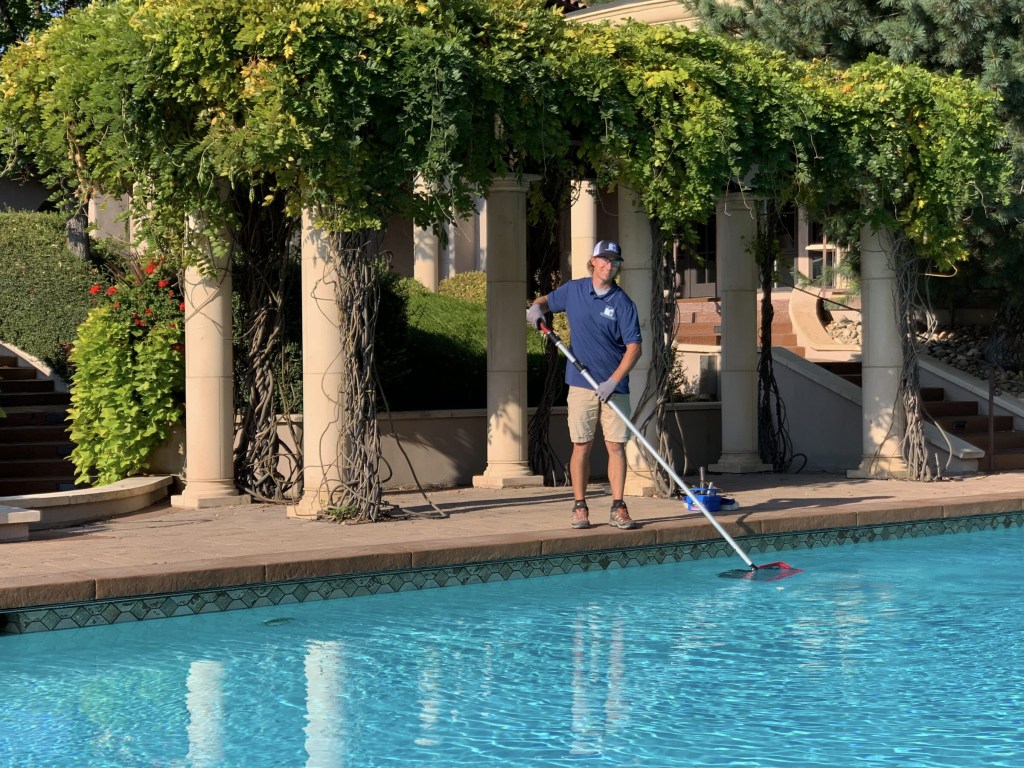
When to Call a Professional Pool Cleaning Service in Denver
A few signs it’s time to hand off pool maintenance to a professional:
Persistent algae keeps returning despite proper shocking usually points to a circulation, filtration, or hidden chemical imbalance issue that needs professional diagnosis.
Water chemistry won’t stabilize pH or chlorine swings wildly between tests despite adjustment, suggesting factors beyond what a home test kit measures (CYA buildup, metals in fill water, failing chemical feeder).
You don’t have time for twice-weekly testing and daily skimming during the busiest months. Denver’s short season means a missed week in July can turn a clean pool into a costly recovery project.
Equipment is making noises, leaking, or underperforming, and mid-summer repair availability in Denver is limited.
Missa Clean handles pool cleaning and maintenance across the Denver metro so you can spend summer in the water instead of managing it. Call (720) 325-1600 for a one-time deep clean, seasonal opening prep, or ongoing weekly service.
FAQs
When should I open my pool in Denver?
Start prep in late May, aim to be swim-ready by the first or second week of June. Denver’s last frost typically falls in mid-May, but late cold snaps can stretch into early June at higher elevations.
How often should I test pool water at altitude?
Twice per week minimum for chlorine and pH. Denver’s hard water causes pH to drift frequently, and chlorine depletes faster at 5,280 feet than at lower altitudes.
Why does my pool lose chlorine so fast in Denver?
UV intensity at altitude breaks down free chlorine faster than in most cities. Adding cyanuric acid (CYA) stabilizer to 30–50 ppm acts as a shield and dramatically slows chlorine loss.
How much does pool cleaning cost in Denver?
Costs depend on pool size, condition, and service scope. Call Missa Clean at (720) 325-1600 for a quote based on your specific pool.
Can I prepare my pool myself, or should I hire a professional?
Most homeowners handle basic opening prep. Professional service adds the most value in water chemistry management at altitude, equipment diagnostics, and consistent weekly maintenance during Denver’s compressed season.